
History

From a technical standpoint, paved roads date back to Antiquity, and Portugal inherited many stone-covered roads from the Roman period, a legacy that the Arabs continued by using smaller stones arranged in a structured manner according to their function. In most cases, this technique was not intended for decorative purposes but purely utilitarian; hence, in Portuguese, the collection of stones laid in this way, juxtaposed, and the streets thus paved came to be generally referred to as calçada (cobblestone pavement). The laying technique of this type of functional pavement is similar to that used in Portuguese artistic pavement, to which the decorative tradition of mosaics was added.
Lisbon during the first half of the nineteenth century, still a city-wide construction site, with the rubble of many buildings destroyed by the 1755 earthquake still punctuating the urban landscape, a new artistic and technical paving solution emerged.
The concept of the square, in the reborn bourgeois city, also asserted itself in contrast to the traditional largo, and it was here that the new social life began to unfold—of a society gradually abandoning ancestral habits of female seclusion, allowing well-off families to be seen and to see others. Lisbon’s appearance during this first half of the nineteenth century underwent the beginnings of such a profound transformation that the city would never be the same again.
Public space began to claim a status as an extension of the private sphere, with the near-simultaneous proliferation of two new highly textile decorative elements that had moved from bourgeois domestic interiors into the streets, bringing with them the comfort of the homes of the rising class—damasks and tapestries covering walls, doilies on furniture, and carpets and runners softening the floors. Outdoors, these elements took on a different nature: tiles moved from religious and palatial interiors to feature openly and democratically on the façades of rental buildings, while mosaic pavement began to cover sidewalks and squares. Complementing these were pieces of urban furniture, which ceased to serve solely utilitarian purposes to gain decorative status, including cast-iron lamps and benches, as well as drinking fountains for people and animals, accompanying the statuary and fountains that, like biblots, rested on stone “doilies.”
Public space was staged to encourage strolling and promenading in the romantic nineteenth-century society, with noble areas beautified and humanised using stone “carpets” to welcome residents and travellers. The versatility of the material allowed for any graphic design to be reproduced. Imagination was liberated, and the creativity of craftsmen and anonymous artists, alongside recognised talents, helped to make everyday life more beautiful and rich. To the luminous and colourful decoration of tiled façades, which were beginning to punctuate the city, corresponded, underfoot, the brightness of the fanciful black-and-white patterns of artistic pavements.
In the city, these two decorative elements stand out, forming a distinctive and highly recognisable identity. Lisbon thus adorned itself, compensating for the lack of monumental architecture. Without them, it would cease to be what it is.
Like tiles, beyond their decorative function, mosaic pavement also serves an advertising purpose when used on the pavement in front of institutional, commercial, or dining establishments, and it can also indicate the building’s door number on the pavement.
Lisbon and its surroundings provided the raw materials in both quality and abundance. White limestone and black basalt were available within the municipal territory, and it is always the materials that define and shape the identity or soul of a place. Basalts and, above all, limestones are used in Lisbon’s architecture. Yet, it is underfoot that they truly stand out.
Functional pavement began to be distinguished, initially composed exclusively of irregular black basalt, mostly sourced from Monsanto (later replaced by granite from other regions), which paved road surfaces used by vehicles and beasts of burden, from sidewalks, which had emerged following the Pombaline reconstruction project, and from other pedestrian areas such as squares and largos, where the whiteness of limestone (also from Monsanto quarries, but equally from Campolide, Fonte Santa, and even Odivelas, for example) was contrasted with black basalt stone or, later, with limestone of the same colour (sourced from Mem Martins and later from other locations). Because it was difficult to work and became more slippery over time, basalt was gradually abandoned on the mainland. Most artistic pavements made today in Lisbon and in many other cities are limited to the use of a single type of rock: limestone of various colours, although black-and-white compositions remain dominant.
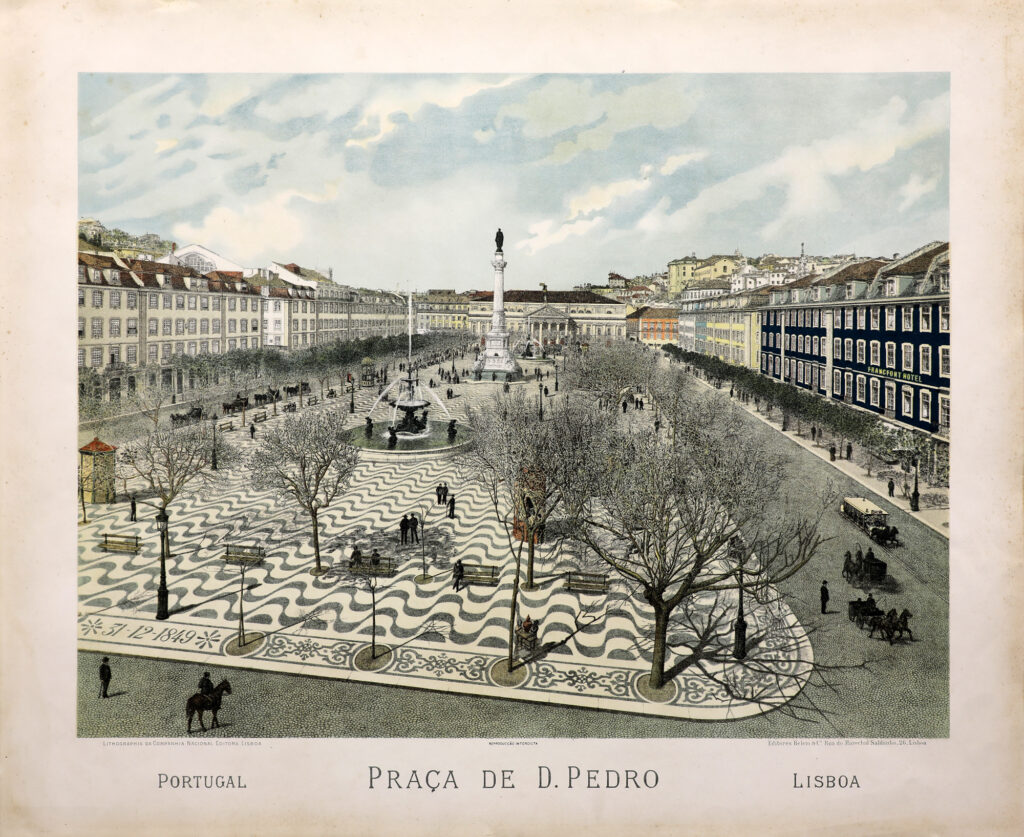
The mosaic pavement system was conceived by the Governor of Arms of São Jorge Castle, Lieutenant-General Eusébio Cândido Cordeiro Pinheiro Furtado (1777–1861), who is considered its inventor. The taste for this type of carved pavement, applied in public spaces, is said to have begun in 1841, when the governor ordered the paving of the military parade ground at the castle, using prisoners, known as grilhetas, due to the chains fastened around their ankles. This was followed by the paving of Rua de Santa Cruz do Castelo. The project was so successful that, in May 1844, the municipality provided resources to extend the work to the pavement of Marquês de Tancos street.
The Teatro Nacional D. Maria II was inaugurated in 1846. At the Rossio, the previous year, vehicle and horse traffic had been prohibited on the central plaza, restricted to circulate around its perimeter. Following this renewal, the City Council approved its paving in April 1848.
The same Lieutenant-General Eugénio Furtado proposed a striking design of black-and-white waves, called the Mar largo, to be executed by the grilhetas from São Jorge Castle, which was approved in July 1848. The work, begun on 17 August 1848, was completed on 31 December 1849, using municipal pavers as the number of grilhetas had decreased. The following year, paving continued in other squares and streets of the city. In 1895, the Lisbon City Council made the use of Portuguese pavement mandatory to standardise sidewalks and squares, a decision reinforced later in the Municipal Master Plan of Gröer (1928–1948). Of course, not all pavement had decorative features; most consisted of common white Portuguese cobblestone pavement without designs.
Some of these early pavements have disappeared, while others were replaced or altered. The Mar largo, for example, disappeared in 1919. However, in a session on 25 June 1979, the municipality unanimously approved its reinstatement, albeit at a smaller scale due to current traffic requirements. It was only from 1995 that it returned during the rehabilitation of Rossio, a project inaugurated in 2001.
Following the initial period of anonymous municipal technicians creating public works in the 1800s, there emerged a phase in which visual artists were invited to design new stone “carpets,” coinciding with the explosion of Portuguese artistic pavement across the country during the first six decades of the twentieth century. Even in the second half of the previous century, the profession of paver had been gaining prominence, as evidenced by the drafting of the statutes for the creation of the Lisbon Pavers’ Trade Association in 1891, with the final version approved by decree on 18 May 1893 and published in the Diário do Governo on 27 September of the same year. This Association appears to have had some influence with official institutions, as evidenced by the awards granted for works of artistic paving. However, the trade seems not to have managed to remain united, for reasons not yet determined, and the Association was dissolved sometime between 1950 and 1960.
However, Portuguese pavement has long ceased to be exclusive to Lisbon, being found throughout mainland and island Portugal, and also—most notably—in countries historically linked to Portugal. Brazil is in fact the non-Portuguese territory where this type of paving has become most established.
The slow decline of the profession began in the 1970s, with the country’s political and socio-economic changes, rising living costs, and demands for higher wages. The work is arduous, poorly paid, and socially undervalued, and therefore fails to attract new generations. Concerned with the prospect of losing the craft, the Lisbon City Council was the first to decide, in 1986, to establish a formal training institution: the Lisbon School of Pavers.