
Techniques

On Portuguese pavement, only the percussion technique is employed. Each paver selects the flattest face of the cube that will remain on the surface and shapes the edges by striking, using the tip of the “pavement hammer” held in one hand, at an oblique angle, with precise blows on the stone held in the hollow of the other hand, at the vertex that is to be removed. By turning the hammer’s handle, they strike with the head on the coarse sand and then place the already cut cube (or other shape), giving it small dry taps with the tip, in order to adjust the fit and ensure it is firmly embedded (up to half the height of the stone).
Thus, the pavers alternately turn the hammer to split the stone with the tip to the correct size for fitting, and then turn the hammer to strike with the head on the stone already placed. If it does not fit at first, they remove it, turn the hammer to split it to give it the necessary shape for proper fitting and locking, like a puzzle, and repeat the process several times until it fits perfectly. Even today, the memory of the “old masters” persists, who competed among themselves for perfection and precision in shaping the stones, not allowing even a thin sheet of rice paper between them.
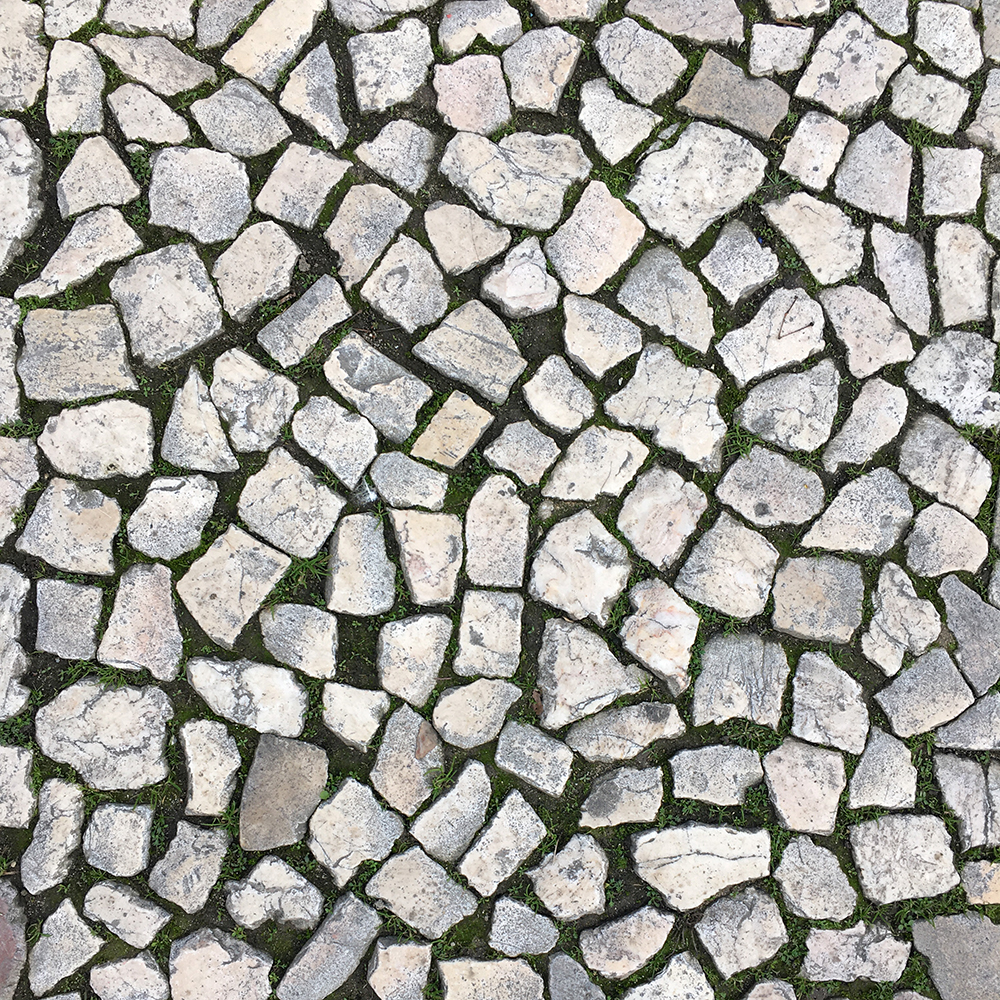


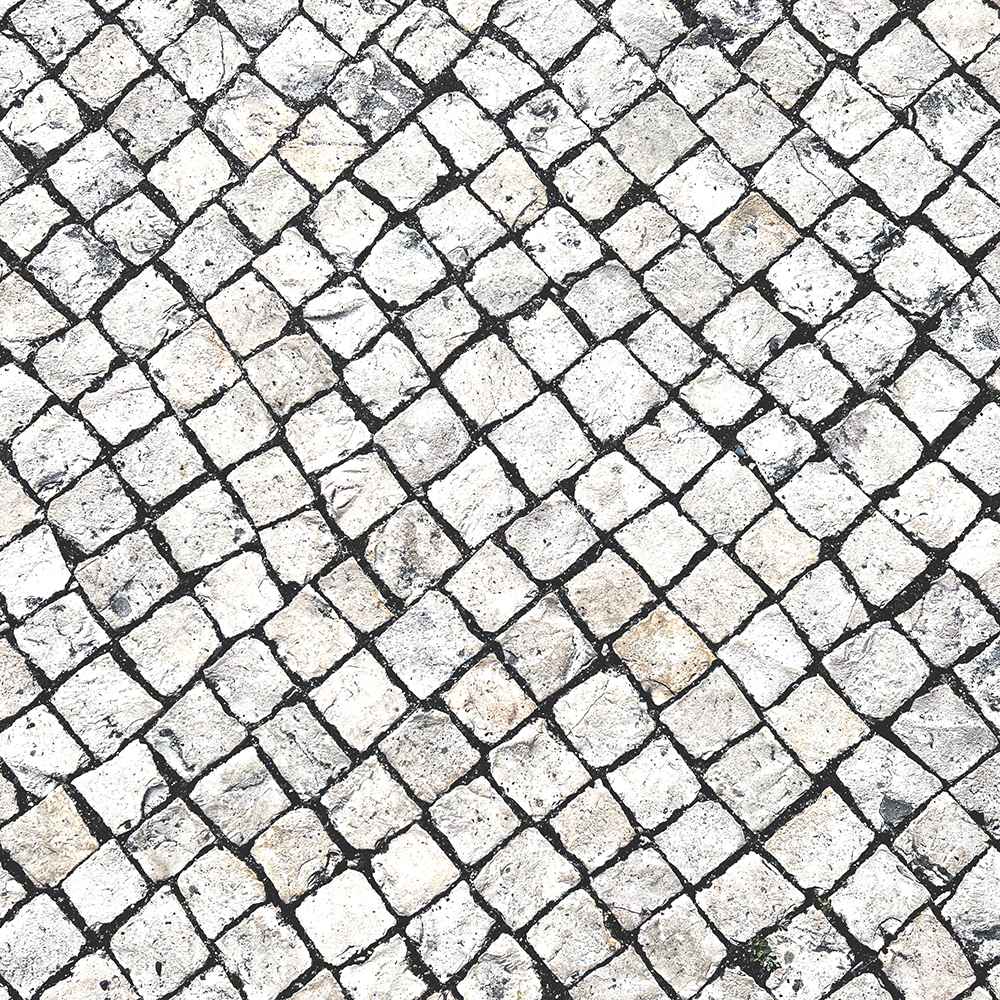
The shape of the floor-face polygon, the size, and the fitting of the stones are what define the various types of artistic paving. Most common types of paving:
- Calçada à portuguesa (Portuguese cobblestone pavement) – the oldest of the techniques, usually made of limestone and basalt, with small stones of variable size and irregular faces, laid randomly but in a way that allows them to fit together. This is a technique that should only be used when the proposed intervention is based on an existing Portuguese cobblestone pavement with these characteristics.
- Malhete – the most sophisticated and challenging of the techniques, the one that best showcases the mastery of a cobblestone paver, in which the stones, of irregular polygonal shape, generally pentagonal, fit together along their edges. When the vertex of a stone extends from the middle of the adjacent edge, it is called a “split malhete”.
- Hexagonal – when the faces of the stones are cut to form regular hexagons, with diameters of approximately 5 centimetres, and the vertices and edges align with the adjacent stones, ultimately presenting the appearance of a honeycomb.
- Square – stones cut into more or less regular cubes, measuring approximately 3×3 to 5×5 cm, fitting face to face. Currently, it is the most common type for large-scale fillings and can be laid in different ways:
- Square-laid – when the cube is laid so that opposite vertices form a perpendicular to the curb, i.e., along the diagonal at a 45-degree alignment. The start of this paving is made with a “bico” (a triangular stone resulting from splitting a cube along the diagonal of one of its faces) or an arrow-shaped stone (a polygonal stone in the shape of an arrow). This is currently the most common arrangement.
- à fiada (In rows) – with the cubic stones aligned in rows parallel to the curb line, forming well-defined bands. This is a relatively recent and rather unremarkable arrangement, introduced for the ease and speed of its application, and one that does not require great skill from the workers.
- Fan – with the stones, generally cubic, laid so as to form various types of fans (or scales): the segmented fan, the Florentine fan, the peacock’s tail, or the shell-shaped fan.
- Circular – with the stone cubes arranged in concentric circles, producing an optical effect of rotation
There is also a whole other series of stone shapes that are generally used to complement the previous ones: in a fan, in an elongated hexagon or hammer shape, in an arrow, in a pear shape, in a triangle, in a circle, and so on.